
 Malaysia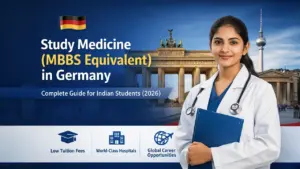
Germany is one of the most respected destinations in the world for medical education. The country offers high-quality education, modern hospitals, internationally recognised degrees, and very low tuition fees in public universities. Many international students choose Germany because of its strong healthcare system and excellent clinical training opportunities. In Germany, the medical programme is called Human Medicine (Humanmedizin), which is equivalent to MBBS in many countries. This guide explains the complete process for Indian students, from application to becoming a doctor in Germany.
Overview of Medical Education in Germany
-
Course Name: Human Medicine (Humanmedizin)
-
Equivalent Degree: MBBS
-
Total Duration: Approximately 6 years and 3 months
-
Language of Instruction: Mostly German
-
Tuition Fees: Very low or free in most public universities
Medical education in Germany includes theoretical studies, laboratory training, and extensive clinical experience in hospitals.
Step-by-Step Process to Study Medicine in Germany
Step 1: Complete 12th (Science Stream)
The journey begins after completing Class 12 with Physics, Chemistry, and Biology (PCB). Students must have strong academic performance, typically 80–95% or higher, along with completion of 12 years of formal schooling. NEET is not required for admission in Germany. However, it is mandatory for Indian students who wish to practise medicine in India later, as per NMC regulations.
Step 2: Learn the German Language
Medical programmes in Germany are primarily taught in German, so language proficiency is essential. Most universities require B2 or C1 level German. Accepted exams include Goethe Certificate, TestDaF (minimum level 4), DSH-2, and telc C1 Hochschule. Students usually need 12–18 months to achieve the required proficiency.
Step 3: Apply for Studienkolleg
Indian qualifications are not directly equivalent to the German Abitur, so students must complete a foundation programme called Studienkolleg. Medical aspirants join the M-Kurs, where they study Biology, Chemistry, Physics, basic Mathematics, and academic German. The duration of this programme is typically one year.
Step 4: Entrance Exam (Aufnahmeprüfung)
Students must pass an entrance test before joining Studienkolleg. The exam evaluates German language skills and basic mathematics knowledge. Some institutions may also test basic science concepts.
Step 5: Complete Studienkolleg
During this phase, students build strong academic and language foundations required for medical studies. They focus on science subjects, German terminology, and academic communication skills.
Step 6: Pass FSP Exam
After completing Studienkolleg, students must pass the Feststellungsprüfung (FSP). The exam includes Biology, Chemistry, Physics, and German, and may consist of written and oral components. Passing the FSP qualifies students to apply to German universities.
Step 7: Apply to Medical Universities
Students can apply through uni-assist or directly through university portals. Admissions are based on FSP scores, language proficiency, academic performance, and sometimes TMS results.
Step 8: Optional TMS Exam
The TMS exam can improve admission chances. It evaluates logical reasoning, scientific understanding, memory, and problem-solving abilities.
Step 9: Receive Admission Letter
Students who meet the requirements receive the admission letter (Zulassungsbescheid), confirming their acceptance.
Step 10: Apply for a Student Visa
Students must apply for a German student visa after receiving admission. Required documents include passport, admission letter, academic certificates, language proof, health insurance, and financial proof. Students must show approximately €11,208 per year in a blocked account.
Step 11: Travel and Enrol
After visa approval, students travel to Germany and complete formalities such as residence registration, bank account setup, and university enrolment.
Structure of Medical Programme in Germany
Pre-Clinical Phase (2 Years)
Students study subjects like Anatomy, Physiology, Biochemistry, and Medical Psychology. This phase ends with the First State Examination (Physikum).
Clinical Phase (3 Years)
Students move into clinical subjects such as Internal Medicine, Surgery, Pediatrics, Neurology, Gynecology, and Pharmacology. They gain practical experience through hospital training.
Practical Year (Final Year)
The final year includes full-time hospital training in Internal Medicine, Surgery, and one elective specialization. Students then appear for the Final State Examination.
Medical License and Career Opportunities
After graduation, students must obtain the Approbation (medical licence). They can work in German hospitals, pursue specialization (Facharzt), or explore opportunities across Europe. Fresh doctors typically earn between €4,500 and €6,000 per month. Germany has a high demand for medical professionals, ensuring strong career prospects.
Advantages of Studying MBBS in Germany
-
Low or no tuition fees
-
High-quality education
-
Modern hospitals and infrastructure
-
Globally recognised degree
-
Strong clinical exposure
-
Excellent career opportunities
-
Possibility of long-term settlement
Admission Guidance
Students should begin preparation early, especially for German language and documentation. GF Global Focus Education Pvt. Ltd. provides expert guidance for students planning to study medicine abroad.
📞 Phone: +91 96921 23000
🌐 Website: www.globalfocus.in
Conclusion
Studying medicine in Germany is an excellent opportunity for Indian students seeking affordable and globally recognised education. With proper planning and dedication, students can build a successful medical career in Germany.